←  Back to the Hall
Bill S-211 · Fighting Against Forced Labour and Child Labour in Supply Chains Act · Canada

Canada's forced-labour law holds you responsible for a supply chain you can't see.

If two of three size thresholds apply, Bill S-211 makes you legally accountable for forced and child labour anywhere in your supply chain, down to suppliers you have never met. The report is due May 31, signed by your board, with a $250,000 penalty behind it — and the 2026 clarifications tightened the reporting thresholds, definitions, and mandatory disclosures. XFACTOR VERIFIED runs the supplier assessment that makes your report defensible, supplier by supplier.

Run the 90-second check
Does S-211 apply to you? Find out below
Federal deadline
May 31
annual report due, signed by your board of directors
Bill S-211 makes the reporting entity responsible for forced and child labour across the whole supply chain, not just its own walls. A $250,000 penalty and personal director liability sit behind a report most teams cannot yet evidence. XFACTOR VERIFIED runs the supplier due diligence that makes it real, supplier by supplier.
0
Doing this by hand
0
Organizations assessed
0
Assessments completed
0
Filings built to survive audit
Trusted across three decades of supply chains
The 90-second check

Does Bill S-211 apply to you?

Answer a few quick questions. Most mid-market companies are in scope, including service and staffing firms that assume they are not. This is a guide, not legal advice, so confirm with your CFO or counsel before you act on it.

01
Do you have a connection to Canada?
Any one of these counts.
02
Your financial size
In either of your last two financial years, consolidated including subsidiaries. The test needs two of three (revenue, assets, employees), so being under one is fine.
Annual revenue (CAD)
Total assets (CAD)
03
How many employees?
Average across the financial year, not a point-in-time headcount.
04
Which describes your business? Select any that apply.
You do not need goods of your own to be caught. Staffing and labour agencies count.
What the law makes your responsibility.

Bill S-211 does not ask whether your own house is clean. It makes you accountable for forced and child labour everywhere your goods come from, including the suppliers behind your suppliers.

Self-attestation is not evidence. The Act expects documented due diligence on the part of the chain you cannot see, and that is exactly where the liability hides.

A compliance lead reviewing supplier documents late at the office
This lands on a person. The compliance lead who has to answer for every supplier.

A blank answer is a red flag. An undocumented policy is, legally, no policy at all. The due diligence the Act demands gets run for you, supplier by supplier, turning claims into evidence you can file.


Non-compliance is not a fine you can quietly pay.

The Act treats failing to file, failing to publish, and filing something false or misleading as offences. The consequences do not distinguish an honest mistake from willful neglect.

$250K
financial penalty per year of non-compliance
Warrantless
inspectors can enter any facility with no notice and no scheduling
Public registry
your company named on a live, searchable URL for customers, investors and press
Personal
directors and officers face personal criminal liability, not just the corporation
This is the slide that ends board debate. The report is due May 31, and your board has to sign it.
WHERE BILL S-211 ACTUALLY HURTS

Five places Bill S-211 puts you on the hook.
Five parts of XFACTOR that close them.

Bill S-211 makes you, personally, responsible for proving your supply chain is free of forced and child labour. Here is what that exposes, and exactly how we handle each one.

The liability lands on the person who signs the report. On you.
The 5-Step Master ReportThe signed evidence behind every claim, so your board-signed report is defensible.
"We sent a questionnaire" is not due diligence.
The live assessmentEach supplier actually assessed for forced and child labour risk, supplier by supplier.
You cannot see forced-labour risk three tiers down.
Cargo Mapping and Risk IntelligenceThe sub-suppliers and high-risk regions you never knew were in your chain, surfaced for you.
A gap you found but never closed is worse than not looking.
The Plan of ActionEvery finding gets an owner, a deadline, and a signature.
The report is due every year, and the law keeps tightening.
Annual reassessmentYour due diligence proven, year over year.

When the audit comes, a risk score won't protect you.
The signed evidence behind your report will.

The other platforms
XFACTOR VERIFIED
A forced-labour risk score from analysts you never see, then they hand you a dashboard
Outcome
You get every supplier run, every gap closed, and each one's signed attestation your S-211 report can stand on
Collect answers and call self-attestation due diligence
Evidence
You get the documents back, policy, audit, sign-off, so your answers become evidence a regulator accepts, not claims
Charge your suppliers to stay listed in their network
Your suppliers
Suppliers join free. The client carries the cost, so partners take part openly
A faceless platform behind a logo wall
Who built it
Mandy-Lynn Aitken, who has run supply-chain and forced-labour due diligence by hand for 30 years
Hidden until you sit through a sales call
Pricing
Flat and published. No per-supplier tax

Seven mandatory categories.
Four of them sink first-time filers.

The policies usually exist. They are just undocumented, and undocumented means, legally, it did not happen. This is where first-time filers actually fail, measured across real filing engagements.

xfactor dashboard / first-time filing gapsLIVE
Documentation gap rate, by mandatory category
Trips first-time filersOther categories
Hover a category to see what trips first-time filers.
Source: XFACTOR analysis of first-year S-211 filing engagements, 2026. n = sample of completed client assessments. Share of first-time filers with incomplete or undocumented responses.
The other three, company structure and supply chains, risk areas, and effectiveness assessment, are where the rest of the work lives. XFACTOR VERIFIED builds all seven from the supplier evidence up, so nothing in your report is a claim you cannot back.
Why the law exists

Behind every line of this report are people. The Act was written for them.

160M
children in child labour worldwide today
79M
in hazardous work that can harm their health or safety
1 in 8
children globally, 12 percent, are in child labour
International Labour Organization, Global Estimates of Child Labour, 2024

What if your whole S-211 report was built from real supplier evidence, without spending a fortune, without the manual work, and without chasing a single supplier yourself?

From self-attestation to a report you can defend.

01
Drop in your suppliers. Morpheus maps the chain and screens each one, no spreadsheet wrangling.INTAKE
02
Each supplier answers the due-diligence assessment in their own language, and is asked for the documents back, not just answers.ASSESS
03
Morpheus reads how they answer, flags the gaps, and stores every supporting document in an audit-ready vault.EVIDENCE
04
The seven mandatory categories drafted from real supplier evidence, in language written to survive an audit.REPORT
05
Your board signs, you submit through the Public Safety Canada portal and publish on your site, before May 31.SIGN & FILE
A real client's published S-211 report, company name redacted
A real client's published report. Filed and live. The name is redacted, the filing is real.
A compliance lead reviewing the finished report, in control
In control, not on the hook. Built from real supplier evidence, not guesswork.
app.xfactorverified.com / reports / master-reportLIVE
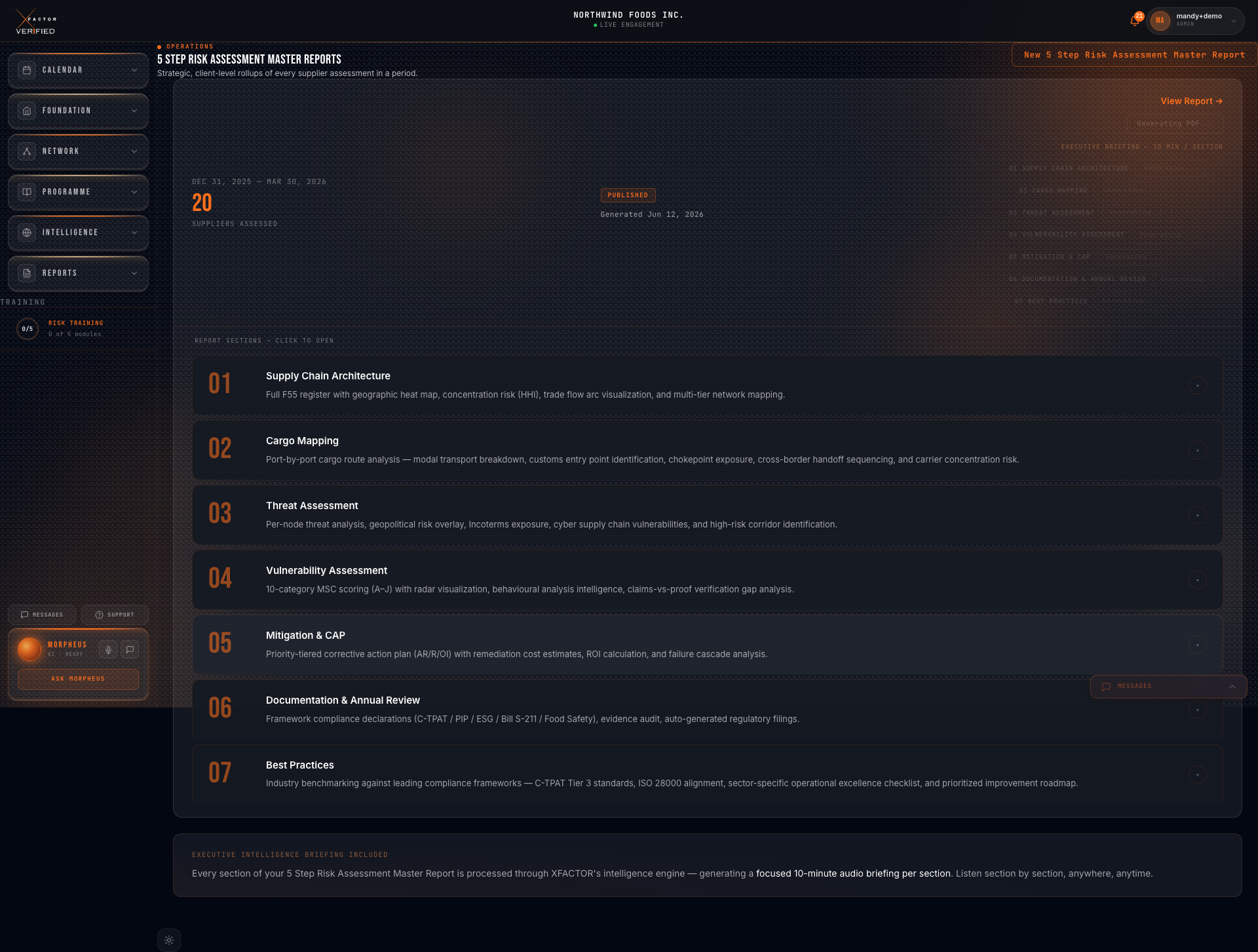
XFACTOR VERIFIED 5-Step Risk Assessment Master Report — all 7 sections, CF score, audit-ready
5-Step Master Report
Your S-211 evidence, assembled and audit-ready.
Assessed. Evidenced. Filed.
Questions you would ask on a sales call

There is no sales call. So here are the answers, straight.

10 questions across two themes: Bill S-211 and your obligations, and the 15-day free trial. Straight answers, no hedging.

About Bill S-211 and your obligations

Bill S-211 makes you, the reporting entity, responsible for forced and child labour across your whole supply chain, not just your own operations. You must carry out documented due diligence on your suppliers: send them a real assessment, demand the supporting documents back, identify and remediate risk, and disclose all seven mandatory categories in an annual report your board signs by May 31. That supplier-by-supplier due diligence is the work XFACTOR VERIFIED runs for you. We are not a report-filing service, we are the platform that runs the supplier assessment the Act holds you responsible for.

You are in scope if you have a connection to Canada and either are listed on a Canadian stock exchange, or meet at least two of three size thresholds in either of your last two financial years: CAD $40M annual revenue, CAD $20M total assets, or 250 average employees. You also have to produce, sell, distribute or import goods, or control a company that does. The 90-second check at the top of this page walks you through it. One threshold is not enough: a company with $80M revenue but only 80 employees and $10M assets does not qualify. Confirm the numbers with your CFO before you act on them.

The report has seven mandatory categories, and four trip most first-time filers because the policies exist but are undocumented. The platform builds each category from real supplier evidence: the 18-question due-diligence assessment, the documents back, audit certificates, corrective-action records, and sub-tier mapping for your high-risk lines. We write what is true and what is documented, because vague language reads as evasion under audit. The founder has run supply-chain and forced-labour due diligence by hand for 30 years.

That is the signal. A supplier who refuses a documented assessment is a high-risk gap, and the Act expects you to identify and act on exactly that. The platform flags non-responders, documents the outreach, and surfaces them in your report. Documented refusal and your response plan is itself evidence that you identified the risk. Refusing to be assessed is a finding in itself, not a blank you leave in the report.

The free trial

Yes. Your first 8 suppliers are completely free for 15 days. No credit card, no sales call, no contract. Your suppliers get assessed with the same due diligence Bill S-211 demands. If you do not see a gap worth more than the ten minutes it takes to start, you have lost nothing. Once you see what surfaces in 15 days, the decision on the rest of your suppliers is easy.

Because showing beats telling. In 15 days you watch real gaps surface in 8 of your own supply chain, at no cost and no risk. If what you find is worth more than the ten minutes it takes to start, the decision on the rest is yours. No demo, no pitch, no pressure.

No card, no contract, no commitment. You drag your supplier list in, Morpheus maps it, and the assessments run. The 15-day trial clock starts the moment your first supplier receives their invite. If you decide to assess the rest of your suppliers after the trial, that is when pricing comes in, and it is published on the site. No sales call required.

Every supplier in the 15-day trial goes through the full intake: email verification, address validation, and watchlist screening against the US Consolidated Screening List (OFAC, BIS, DDTC). Then each supplier receives the cinematic scenario assessment, narrated by Morpheus, behaviourally scored. You get findings, gap analysis, and a Corrective Action Plan for every gap found. The only thing gated behind a paid plan is assessing more than 8 suppliers and accessing the full Master Risk Assessment Report for your entire supply chain.

For you, setup is minutes. You upload your supplier list and Morpheus handles the intake: email verification, address check, watchlist screening, and tier assignment. Suppliers typically complete their scenario assessment in 20 to 40 minutes. The trial window is 15 days, and most teams see findings well before the midpoint. You do not reformat a spreadsheet and you do not chase anything manually.

No. The platform handles outreach automatically. Once you upload your list, Morpheus sends each supplier their assessment invitation, follows up with a Day 3 nudge and a Day 7 nudge if they have not responded, and tracks completion status in your dashboard in real time. You see who has finished, who is in progress, and who has not opened it yet, without sending a single email yourself.

8 suppliers · 15 days · free

Run the S-211 supplier due diligence on your highest-risk suppliers. Free for 15 days.

See every documentation gap within your 15-day trial window, not the months a consultant takes.
No sales call. No credit card. No contract. Trial starts when your first supplier gets their invite.
Drag your list in. Morpheus maps and screens. You reformat nothing.

If we don't surface a gap worth more than the ten minutes it takes to start, you've lost nothing.

Start my free assessment
Founder
30 YEARS · 44,000 ORGANIZATIONS · 500,000 ASSESSMENTS · SUPPLY-CHAIN DUE DILIGENCE BUILT TO SURVIVE AUDIT.
Built by the expert who has spent a career inside these programs, for the teams who live them.
The XFACTOR family · zero to hero on Bill S-211

One program. Four products walking you there.

Every product below works on its own — or as a section inside your CommandCenter. Same service, two homes. This is the road from zero to hero on Bill S-211.

Command

Command the program

Run Bill S-211 end to end inside XFACTOR COMMANDCENTER: your security profile answered once in your own voice, department-specific training with real testing, the security committee rhythm, procedures and forms kept current against the regulators, monthly self-audits, and the annual internal assessment — through six department cockpits and one calendar. Carry more than one program, and one answer publishes to every program that asks the same question.

See XFACTOR COMMANDCENTER →
Assess

Assess your suppliers

XFACTOR VERIFIED runs the 5-Step risk assessment on every supplier you answer for under Bill S-211 — regulatory certificates tracked, whole supply chains mapped, and a 300-to-600-page master report that turns supplier risk into signed, audit-ready proof. Never a per-supplier fee.

See XFACTOR VERIFIED →
Be ready

Be ready for your government review

When your officer review comes, XFACTOR VALIDATED has already made you ready: a mock officer visit per department from a question bank built on real reviews, a prep playbook, and — after the visit — a response engine that turns the officer’s actual findings report into corrective actions and drafted responses in your own approved language. Live inside CommandCenter today, standalone in August.

See XFACTOR VALIDATED →
See further

See further

XFACTOR VANTAGE is the intelligence layer over everything the family sees — ESG recommendations, automation recommendations, and the stats flywheel. Coming soon; no promises before it’s real.

A first look at VANTAGE →
Supply chain security · Built by a 30-year expert

Your supply chain has a gap
S-211 makes you answer for.

8 suppliers. 15 days. No credit card. Run the real S-211 due diligence on your highest-risk suppliers and see the documentation gaps before an auditor does.

30
Years
44,000
Organizations
300,000
Trained

Mandy-Lynn Aitken · 30 years · C-TPAT · PIP · Bill S-211 · 44,000+ organizations assessed

The XFACTOR Risk Brief

Weekly C-TPAT, Bill S-211, and ESG regulatory intelligence for importers.

Show me my gaps →