←  Back to the Hall
ESG · Environmental · Social · Governance

Your ESG report is only as true as your worst supplier.

ESG is moving from voluntary to mandatory. It is not yet broad law in Canada, but the OECD framework Canada follows expects it, and the moment you sell into the US or EU, your customers' due-diligence laws become your obligation, for every supplier in your chain, not just your own walls. XFACTOR VERIFIED maps your suppliers, assesses each one, and proves the claims, supplier by supplier, so your disclosure holds up.

Show me my gaps
8 suppliers · 15 days · no credit card
The new reality
50 countries
now adhere to the OECD supply-chain due-diligence Guidelines (OECD)
ESG due diligence is increasingly the law, not a voluntary report. It makes you responsible for mapping and verifying your suppliers' environmental and human-rights record. One unmapped supplier, one unverified claim, and that is the exposure a regulator or buyer acts on. XFACTOR VERIFIED proves it, supplier by supplier.
0
Doing this by hand
0
Organizations assessed
0
Assessments completed
0
Audit-ready track record
Trusted across three decades of supply chains

Has proving your suppliers' ESG record become one more report you do not have the data to defend?

Your disclosure goes out every year. Every claim in it rests on a supplier you may never have audited. One unverified line, and it is your name on the filing.

ESG used to be a brochure. Now it is the law.

A wave of due-diligence legislation has turned voluntary reporting into legal obligation, and every one of these laws holds you responsible for your suppliers, not just your own walls. A self-declared scorecard does not satisfy them. Verified, documented due diligence does.

UN Global Compact
The Ten Principles: human rights, labour, environment, anti-corruption
EU CSDDD
Corporate Sustainability Due Diligence Directive
Germany LkSG
Supply Chain Due Diligence Act
French Duty of Vigilance
Duty of care across the value chain
Norway Transparency Act
Human-rights due diligence and disclosure
OECD Guidelines
The benchmark all of the above are built on

Every one of these names the buyer, not the supplier. Most are EU and OECD. Canada has no broad ESG law yet, but the day you sell into the US or EU, your customers' rules become yours. XFACTOR runs the risk-based due diligence they require, supplier by supplier, and documents the proof before a regulator or a customer asks for it.


Sustainability director at a cranberry harvest, farm workers in the bog behind her
The sustainability lead who signs the disclosure. The forced-labour risk two tiers up the bog becomes her liability. We verify it before it does.
The three pillars, and the law behind each

ESG is three promises. You make all three for your suppliers.

Environmental, Social, Governance. Each one is now backed by due-diligence law that holds you responsible for your suppliers, not just your own operations. Here is what each pillar demands, and how XFACTOR verifies it across your chain.

E
Environmental
Environmental management, greenhouse-gas inventories, water, forests and biodiversity, assessed across your upstream supply chain, not just your own site.
Backed byOECD Guidelines · CDP · GRI 308 Supplier Environmental Assessment
XFACTOR maps each supplier's environmental footprint and verifies the evidence behind every claim.
S
Social
Human rights across the value chain: no forced or child labour, no discrimination, safe conditions, fair wages, the right to organize.
Backed byOECD Guidelines · UN Global Compact · GRI 414 Supplier Social Assessment
XFACTOR assesses every supplier for the human-rights risks the law makes yours, and documents the proof.
G
Governance
Anti-corruption due diligence throughout the supply chain, sound governance, and accurate disclosure of material impacts.
Backed byOECD Guidelines · GRI 205 Anti-corruption · IFRS S1 and S2
XFACTOR verifies each supplier's governance and anti-corruption controls, and keeps the record audit-ready.

One assessment covers all three pillars, supplier by supplier, the way the OECD six-step due-diligence process expects.

Prove all three

Risk is not spread evenly across your base.
It pools in a tail you can name.

Most of your suppliers sit in the safe band. The exposure lives in the tail, the few whose environmental, social or governance evidence does not hold. Due-diligence law expects you to find that tail and act on it, supplier by supplier.

xfactor dashboard / supplier ESG risk densityLIVE
Hover a pillar to see where its suppliers sit, and how many fall in the high-risk tail.
Within toleranceHigh-risk tail
Illustrative. Real distributions stay private, live in the XFACTOR dashboard.

Your suppliers' practices are becoming your liability.

A forced-labour allegation two tiers up. An emissions claim you cannot evidence. A supplier in a high-risk region you never mapped. The regulator does not ask what you intended. It asks what you verified.

Sept 2024
new forced-labour compliance requirements took effect under CTPAT; failure can mean suspension or removal from the program
50 countries
adhere to the OECD due-diligence Guidelines that the EU, German, French and Norwegian supply-chain laws are built on
An ESG claim you cannot prove is the most expensive line in your report.
WHERE ESG ACTUALLY HURTS

Five places ESG puts you on the hook.
Five parts of XFACTOR that close them.

ESG makes you prove your suppliers meet the standards your buyers and regulators now write into the contract. Here is what that exposes, and exactly how we handle each one.

Buyers and regulators want proof, not your ESG statement.
The 5-Step Master ReportThe evidence behind every claim, supplier by supplier.
You cannot prove a chain of custody you cannot see.
Cargo MappingEvery tier mapped, every supplier traced.
A self-reported supplier survey is not evidence.
The live assessmentScored on how they really operate, not self-declared.
Environmental and social fraud hides in the suppliers you never check.
Risk IntelligenceThe concentration risk and the outliers surfaced on one live map.
CSDDD and LkSG expect continuous due diligence, not a one-time audit.
Annual reassessmentYour proof refreshed every year, with the history to back it.

A platinum scorecard is not due diligence.

EcoVadis and the rating platforms hand you a supplier's medal, scored by analysts you never see.
Our intelligence system assesses every supplier directly and shows its work: an assessment you can interrogate, not a black-box score.
A medal is a snapshot in time, then they walk away.
The system runs the full arc, assess, find the gap, build the corrective plan, re-assess, and verify it closed and signed.
They charge your suppliers to be rated, year after year.
Your suppliers join free on a Compliance Passport, so they take part openly instead of hiding from a fee.
They benchmark sustainability in general.
We map and verify your actual suppliers against the laws that name you, and one assessment carries across your other programs.
A faceless platform behind a logo wall.
Built and run by Mandy-Lynn Aitken, who has done supply-chain due diligence by hand for 30 years.

This is what an auditor sees when they walk your chain.

Not a self-declared scorecard. A guided assessment each supplier completes, scored against the environmental and human-rights criteria the law names, with every answer on record.

portal / scenarioLIVE
Scenario 1 of 5 · Supplier due diligence
Morpheus
MorpheusA supplier passes their own audit. Watch the field behind them, and tell me what the certificate does not show.
app.xfactorverified.com / intelligence?view=intelLIVE
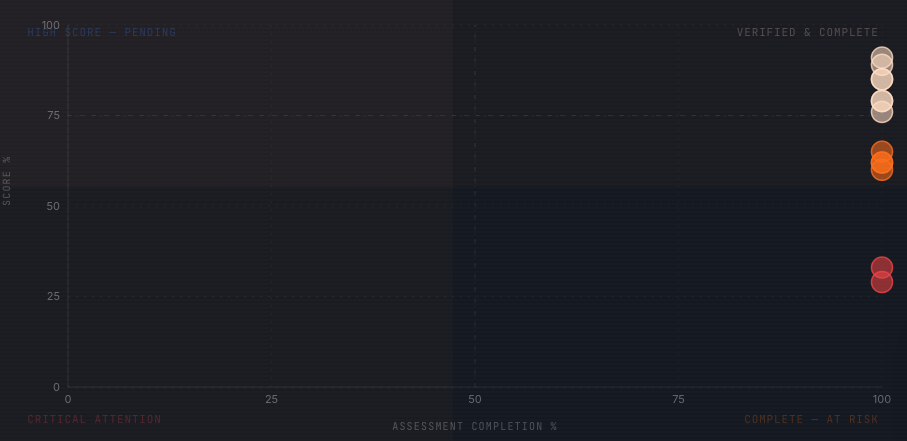
XFACTOR VERIFIED Risk Intelligence Matrix: 4-quadrant scatter of all suppliers by assessment completion and score
Risk Intelligence Matrix
Every supplier positioned by risk. Auto-generated from their own evidence.
A glimpse, not a blueprint. The full system is what your suppliers walk, not what your competitors copy.

What if one assessment satisfied every ESG framework at once, without spending a fortune, without the manual work, and without chasing a single supplier?

From a claim you hope holds to a record you can defend.

01
Drop in your suppliers and sites. Morpheus maps your supply chain, no spreadsheet wrangling.INTAKE
02
Each supplier runs the assessment as cinematic scenarios, in their own language, scored against the environmental, social and governance criteria.PROFILE
03
Every gap becomes a finding; every finding a corrective action plan with an owner and a deadline.CORRECT
04
The whole supply chain documented and audit-ready, the way the OECD six-step due-diligence process expects.MAINTAIN
05
One assessment maps to your other obligations, the OECD framework, your GRI disclosure and your CDP submission, so you report once.ONE RECORD
Found. Corrected. Signed.
Questions you would ask on a sales call

There is no sales call. So here are the answers, straight.

Two themes: ESG and your obligations first, then the 15-day free trial. Straight answers, no hedging.

About ESG and your obligations

In Canada, broad ESG is not yet law, but the moment you sell into the US or EU, your customers' due-diligence laws (the EU CSDDD, Germany's LkSG) and the OECD framework Canada follows require you to run risk-based due diligence on your suppliers: map your supply chain from raw materials to finished goods, identify high-risk regions and suppliers, assess them against environmental and human-rights criteria, document the evidence, and remediate what you find, up to terminating non-compliant suppliers. That supplier-by-supplier work is what XFACTOR VERIFIED runs for you, end to end. We are not a certification service, we are the platform that handles what the law requires you to do with your suppliers.

All of them, from one assessment. The OECD Guidelines are the benchmark every supply-chain due-diligence law is built on, adhered to by 50 countries. We assess your suppliers against the environmental and social criteria those frameworks name, including GRI's Supplier Environmental Assessment (308) and Supplier Social Assessment (414), and align the record with CDP and IFRS S1 and S2 disclosure. You run the evidence once and it serves every report.

Yes. The platform assesses each supplier against the environmental, social and governance criteria the law names, then documents current evidence, findings, corrective actions and remediation, the way the OECD six-step due-diligence process expects. It is built to stand up to a regulator, an auditor, or a customer's procurement team, not just produce a good-looking report. The founder has a career-long record across these programs.

That is the signal. A supplier who refuses a documented ESG assessment is a risk you have now identified, which is itself part of due diligence. The platform flags non-responders, documents the outreach, and surfaces them as a high-risk gap. The law expects you to assess, mitigate, and where necessary terminate suppliers who cannot demonstrate compliance, so a documented refusal and your response plan is evidence you did your part. Refusing to be assessed is a finding in itself.

The free trial

Yes. Your first 8 suppliers are completely free for 15 days. No credit card, no sales call, no contract required. We assess them with the same methodology a regulator-grade ESG audit uses. If we do not surface a gap worth more than the ten minutes it takes to start, you have lost nothing. We run it free because once you see what the platform finds in 15 days, the conversation about the rest of your supplier base is easy.

Because showing beats telling. In 15 days you watch real gaps surface in 8 of your own supplier base, at no cost and no risk. If what you find is worth more than the ten minutes it takes to start, the decision on the rest is yours. No demo, no pitch, no pressure.

No card, no contract, no commitment. You drag your supplier list in, Morpheus maps it, and the assessments run. The 15-day trial clock starts the moment your first supplier receives their invite. If you decide to assess the rest of your supplier base after the trial, that is when pricing comes in, and it is published on the site. No sales call required.

Every supplier in the 15-day trial goes through the full intake: email verification, address validation, and watchlist screening against the US Consolidated Screening List (OFAC, BIS, DDTC). Then each supplier receives the cinematic scenario assessment, narrated by Morpheus, behaviourally scored. You get findings, gap analysis, and a Corrective Action Plan for every gap found. The only thing gated behind a paid plan is assessing more than 8 suppliers and accessing the full Master Risk Assessment Report for your entire supplier base.

For you, setup is minutes. You upload your supplier list and Morpheus handles the intake: email verification, address check, watchlist screening, and tier assignment. Suppliers typically complete their scenario assessment in 20 to 40 minutes. The trial window is 15 days, and most teams see findings well before the midpoint. You do not reformat a spreadsheet and you do not chase anything manually.

No. The platform handles outreach automatically. Once you upload your list, Morpheus sends each supplier their assessment invitation, follows up with a Day 3 nudge and a Day 7 nudge if they have not responded, and tracks completion status in your dashboard in real time. You see who has finished, who is in progress, and who has not opened it yet, without sending a single email yourself.

8 suppliers · 15 days · free

Run your highest-risk suppliers through a full environmental, social and governance assessment. Free for 15 days.

See every gap within your 15-day trial window, not the months a consultant takes.
No sales call. No credit card. No contract. Trial starts when your first supplier gets their invite.
Drag your list in. Morpheus does the mapping. You reformat nothing.

If we don't surface a gap worth more than the ten minutes it takes to start, you've lost nothing.

Show me my gaps
Founder
30 YEARS · 44,000 ORGANIZATIONS · 500,000 ASSESSMENTS · 100% AUDIT-READY TRACK RECORD.
Built by the expert who has spent a career inside these programs, for the teams who live them.
The XFACTOR family · zero to hero on ESG

One program. Four products walking you there.

Every product below works on its own — or as a section inside your CommandCenter. Same service, two homes. This is the road from zero to hero on ESG.

Assess

Assess your suppliers

XFACTOR VERIFIED runs the 5-Step risk assessment on every supplier you answer for under ESG — regulatory certificates tracked, whole supply chains mapped, and a 300-to-600-page master report that turns supplier risk into signed, audit-ready proof. Never a per-supplier fee.

See XFACTOR VERIFIED →
Command

Command the program

Your security program doesn’t stop at one commitment. XFACTOR COMMANDCENTER commands the certification programs you answer to government for — C-TPAT, PIP, AEO, and Bill S-211 — with six department cockpits, real training, monthly self-audits, and one calendar, so the whole program stands behind what your ESG work claims.

See XFACTOR COMMANDCENTER →
Be ready

Be ready for your government review

For the government programs you also carry, XFACTOR VALIDATED keeps you ready for the day an officer reviews your program: mock officer visits per department, a prep playbook, and a post-visit response engine that answers the real findings report in your own approved language. Live inside CommandCenter today, standalone in August.

See XFACTOR VALIDATED →
See further

See further

XFACTOR VANTAGE is the intelligence layer over everything the family sees — ESG recommendations, automation recommendations, and the stats flywheel. Coming soon; no promises before it’s real.

A first look at VANTAGE →
ESG due diligence · Built by a 30-year expert

Your ESG report rests on suppliers
you haven't verified.

8 suppliers. 15 days. No credit card. Run a full environmental, social and governance assessment on your highest-risk suppliers and see exactly what a regulator would find first.

30
Years
44,000
Organizations
300,000
Staff Trained

Mandy-Lynn Aitken · 30 years · C-TPAT · PIP · Bill S-211 · 44,000+ organizations assessed

The XFACTOR Risk Brief

Weekly C-TPAT, Bill S-211, and ESG regulatory intelligence for importers.

Show me my gaps →