CBSA's Partners in Protection program asks for a documented risk assessment, the Minimum Security Requirements, and proof that you check your business partners. XFACTOR CommandCenter gives you one place to run the assessment, track what is missing, and keep your evidence together for the site validation. Members can use FAST lanes where eligible.
PIP certification means membership in the Canada Border Services Agency's Partners in Protection program. CBSA grants it. In brief, from CBSA:
The full eligibility list and all six application steps are in PIP certification in Canada: who can apply, 6 steps, CBSA charges no membership fee. The rest of this page is about what comes after approval.
Has keeping your supply chain compliant become a full-time job on top of your full-time job?
Your suppliers are exhausted. Questionnaire fatigue is real. And every time they push back, it lands on you.
PIP looks like a security checklist. It's a behavioral validation. A CBSA review rarely fails you on a missing fence, they fail you on the distance between what a partner wrote on a form and what actually happens on the floor: at the end of a double shift, on the load that's already late, when the trained manager is away.
That distance has a name: the human factor. Not negligence, but people doing their best in moments no procedure prepared them for. It hides in the three places almost no assessment looks:
A form can't see a moment like that. A person under pressure can't be audited by a questionnaire. That's where every breach actually begins, and it's exactly what we built XFACTOR to walk into, partner by partner, and close before it reaches your Canadian border.
Flip each area. Tick the boxes your team can honestly prove today, for every partner. Watch your exposure.
You can complete 0 of 15.
A CBSA review will find the other 15.
These criteria were written for a border services officer, not a logistics team with a day job. Request a demo and we'll walk you through what an assessment of your highest-risk partners covers.
Show me my real gapsAnd the gap is already moving.
One partner who won't be assessed. One CBSA review that lands before you're ready. One client who asks for your PIP standing and doesn't wait for the answer.
When budgets tighten, partner security is the first thing companies cut, and the one gap CBSA finds first.
Getting into PIP is the application. Keeping PIP status is the job: a standing program with named owners, a yearly review of your own risk, and evidence you can put on the table when CBSA asks. For the requirements and the application steps, see PIP certification in Canada: who can apply, 6 steps, CBSA charges no membership fee. This page is about running the program once you hold it.
CBSA's minimum security requirements set a yearly rhythm for members.
On a longer cycle, CBSA's memorandum D23-1-1 describes revalidation as “a renewed site visit or alternate form of validation” that occurs every four years (para 63), and a member is subject to revalidation no later than one year following the four year anniversary date (para 29). If a member stops meeting the requirements, CBSA can suspend membership. Suspension interrupts all benefits, is temporary, and leads to either reinstatement or cancellation. Members have 30 calendar days to correct the issue, with an extension available on written request.
CommandCenter keeps last year's answers, shows what moved, and turns every gap into a corrective action, so the yearly review is a comparison and not a restart.
Sources, checked 6 November 2026: CBSA, Partners in Protection: program page, how to apply, minimum security requirements, Memorandum D23-1-1.
Each year your program should look at its own risk first: your facilities, your conveyances, your documents and your business partners. CommandCenter keeps last year's answers, shows what moved, and turns every gap into a corrective action, so the review is a comparison and not a restart. See also the 5-step supply chain risk assessment.
PIP touches more than the compliance desk. Operations holds cargo and conveyance practices, procurement holds partner selection and screening, HR holds personnel security, IT holds access and records. CommandCenter assigns each requirement to a department owner with a due date, so nothing sits with “someone in compliance.” See the views for Operations, Procurement, HR and IT.
Every partner assessment, signed corrective action and re-attestation sits in one record, ready to export. When a review is scheduled you open the file instead of building it. Answers you give once can serve the other programs they apply to, such as CTPAT and AEO. Compare the three in CTPAT vs PIP vs AEO.
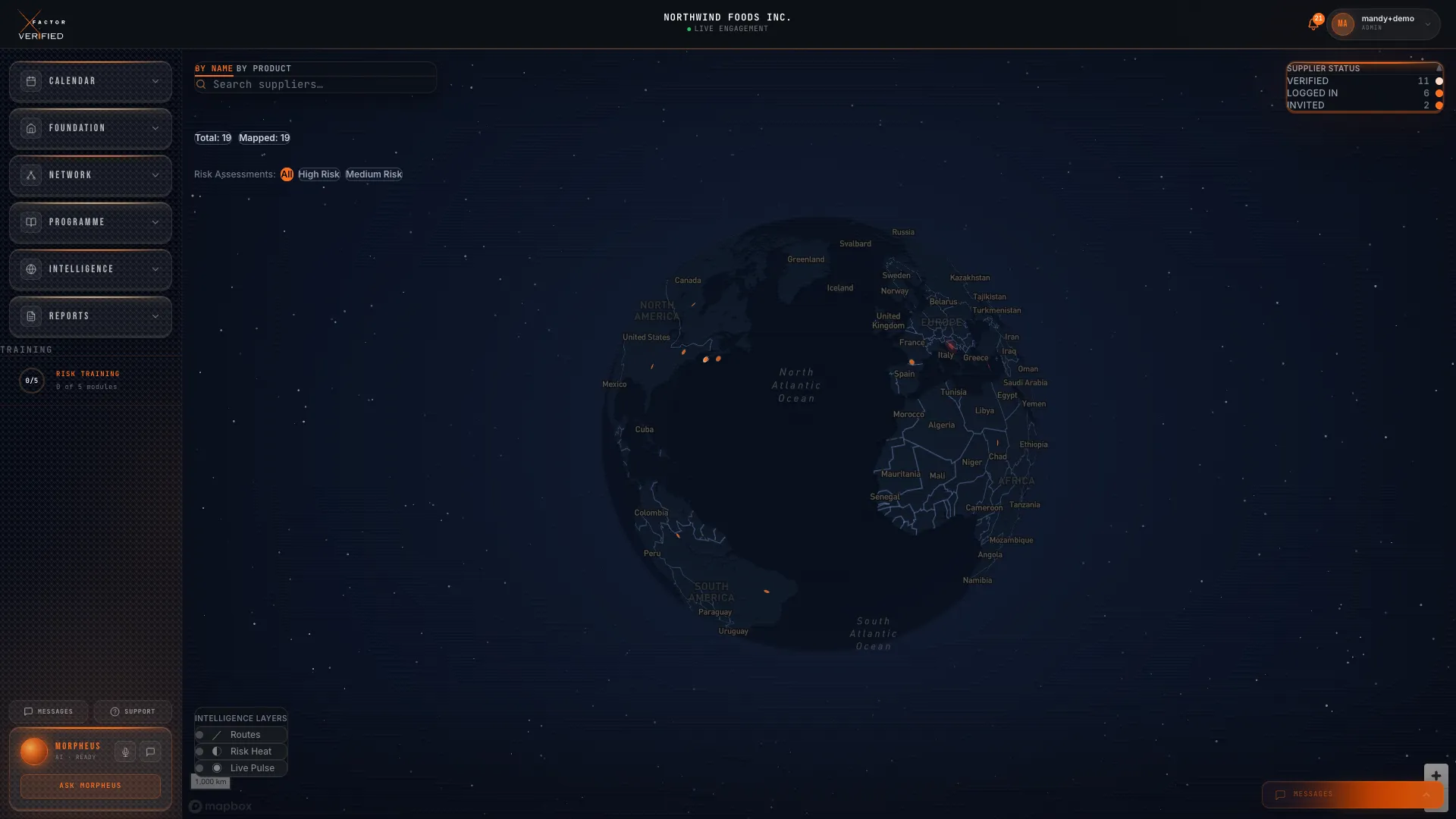
PIP makes you responsible for every partner that touches your freight across the Canadian border. Here is what that exposes, and exactly how we handle each one.
This is what your partners walk and what your board sees, every partner scored, every gap tracked to a signature.
What if one assessment closed your entire partner chain, without spending a fortune, without the manual work, and without chasing a single partner yourself?
CBSA groups the Minimum Security Requirements into four focus areas (corporate security, cargo and conveyance security, physical security, and supply chain partner security) across ten security categories, as set out in CBSA memorandum D23-1-1. You describe how you meet each one in your security profile and keep your risk assessment current. CommandCenter lists the PIP requirements, shows what you have documented, and shows what is still open.
PIP and CTPAT are separate programs: CBSA runs one, U.S. CBP runs the other, and each has its own application and its own validation. CBSA memorandum D23-1-1 notes that, with a member's authorization, CBSA may exchange information with the U.S. CTPAT program. CommandCenter keeps both programs in one account, and an answer you give once can serve every program it applies to. Each authority still decides for itself.
In a PIP validation, a CBSA officer visits your facilities to check that you meet the Minimum Security Requirements. You prepare the documents, the seal and access logs, and your people. CommandCenter lists the procedures and records that are still missing and keeps your evidence together so it can be produced on request. It cannot promise an outcome; CBSA makes that decision.
Two themes: the demo, and PIP itself. Straight answers, no hedging.
Request a demo: 30 minutes with Mandy. We walk through your program and what an assessment covers. Request a demo
Then each supplier receives the cinematic scenario assessment, narrated by Morpheus, behaviourally scored. You get findings, gap analysis, and a Corrective Action Plan for every gap found.
For you, setup is minutes. You upload your supplier list and Morpheus handles the intake: email verification, address check, watchlist screening, and tier assignment. Suppliers typically complete their scenario assessment in 20 to 40 minutes. You do not reformat a spreadsheet and you do not chase anything manually.
No. Once you upload your list, Morpheus sends each supplier their assessment invitation, follows up with a Day 3 nudge and a Day 7 nudge if they have not responded, and tracks completion status in your dashboard in real time. You see who has finished, who is in progress, and who has not opened it yet, without sending a single email yourself.
Keeping PIP status is an ongoing program: an annual internal risk assessment, documented screening and monitoring of every business partner, corrective actions that are closed and signed, and evidence kept current. On CBSA's cadence, that is a yearly profile review in the Trusted Trader portal, a risk assessment reviewed at least once a year, and revalidation every four years. CommandCenter holds that record in one place so the program does not depend on one person's memory.
Members review and update the security profile in the Trusted Trader portal every year. CBSA's memorandum describes revalidation as “a renewed site visit or alternate form of validation” that occurs every four years (para 63), and a member is subject to revalidation no later than one year following the four year anniversary date (para 29).
CBSA describes PIP as a voluntary program and charges no membership fee. The ongoing work is the yearly review, the training records and the partner evidence.
PIP spans several departments. Operations owns cargo and conveyance practices, procurement owns partner selection and screening, HR owns personnel security, and IT owns access control and records. CommandCenter assigns each requirement to a named owner with a due date and shows the open items by department.
It is your own yearly review of where your security program could fail, covering facilities, conveyances, documents and business partners, followed by corrective actions for each gap. CommandCenter keeps prior-year answers so you can see what changed and what is still open.
Your written partner screening process, each partner's assessment and risk report, the corrective actions with owners and sign-off dates, and your latest internal risk assessment. CommandCenter stores these together so they can be produced on request.
No. The application and minimum security requirements are the entry step, covered on XFACTOR VERIFIED. PIP certification management is what follows: holding the standing, refreshing evidence each year and keeping every department accountable. That is what CommandCenter runs.
PIP is CBSA's trusted-trader program for importers and their supply chain partners who move goods across the Canadian border. CBSA describes it as a voluntary program with no membership fee. Per CBSA, members get expedited border clearance through designated FAST lanes, a lower examination rate at the border, and Trusted Trader status in other countries under CBSA's list of mutual recognition arrangements. If you or your partners cross the Canadian border regularly, PIP standing affects the speed and cost of your shipments.
CBSA reviews your security personnel and oversight, physical access controls, cargo and conveyance security practices, document integrity procedures, and your business partner vetting process. The review is not a form submission. CBSA looks for documented evidence of each area actually being managed, not self-attestation. A gap is the distance between what your security plan says and what a reviewer finds at the partner site.
CBSA describes PIP as an Authorized Economic Operator (AEO) program aligned with the WCO SAFE Framework (memorandum D23-1-1, para 4). With the member's authorization, CBSA may exchange program information with the U.S. CTPAT program or another AEO program under an established mutual recognition arrangement (para 52). The programs stay separate: each has its own application, standards and review, and each authority decides for itself. In CommandCenter, an answer you give once can serve every program it applies to.
That is the signal. A partner who refuses a documented security assessment is not a partner you want moving your freight across the Canadian border. The platform flags non-responders, documents all outreach attempts, and surfaces them as a high-risk gap in your Master Report. For a CBSA review, documented refusal and your response plan is evidence that you identified and acted on the risk. Refusing to assess is a finding in itself.
Every product below works on its own, or as a section inside your CommandCenter. Same service, two homes. This is the road from zero to hero on PIP.
Run PIP end to end inside XFACTOR COMMANDCENTER: your security profile answered once in your own voice, department-specific training with real testing, the security committee rhythm, procedures and forms kept current against the regulators, monthly self-audits, and the annual internal assessment, through six department cockpits and one calendar. Carry more than one program, and one answer publishes to every program that asks the same question.
See XFACTOR COMMANDCENTER →VERIFIED, inside CommandCenter, runs the 5-Step risk assessment on every supplier you answer for under PIP: regulatory certificates tracked, whole supply chains mapped, and a 300-to-600-page master report that turns supplier risk into signed, audit-ready proof. Never a per-supplier fee.
See VERIFIED →When your officer review comes, XFACTOR VALIDATED has already made you ready: a mock officer visit per department from a question bank built on real reviews, a prep playbook, and, after the visit, a response engine that turns the officer’s actual findings report into corrective actions and drafted responses in your own approved language. Live inside CommandCenter today, standalone in August.
See XFACTOR VALIDATED →
XFACTOR VANTAGE is per-department automation and savings: it finds where each department loses hours and dollars, sizes every leak, and ranks the automations that take them back. Included in every CommandCenter package, or on its own.
See XFACTOR VANTAGE →Applying, or checking whether your suppliers are ready? Read PIP certification in Canada: who can apply, 6 steps, CBSA charges no membership fee. Or Have your suppliers assessed for PIP in XFACTOR VERIFIED.
Request a demoA gift from XFACTOR COMMANDCENTER
The checklist and worksheet to start your PIP 2027 preparation on Monday morning. It is our gift to you, and it goes to your inbox right away.
Your gift is on its way
The PIP 2027 Monday checklist is on its way to you now. If you do not see it in a few minutes, look in your spam folder.
Go deeper: PIP certification checklist